
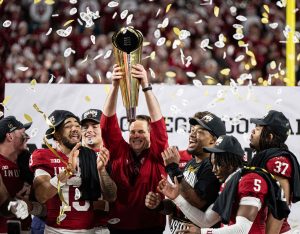
Having attended Indiana University in the early ’90s and a season-ticket holder since ’97, IU football has historically been a program defined by struggle. For decades, the Hoosiers were the loveable underdogs of the Big Ten, often fighting just to reach bowl eligibility. Then, in November of 2023, came Curt Cignetti. What has transpired over the past two seasons, in stunning fashion, culminated in a national championship on Monday, January 19th. Coach Cignetti hasn’t just won games however; he has rewritten the culture of an institution.
At the root of this extraordinary shift lies Coach Cignetti’s unmistakable and “old school” philosophy: process-driven, disciplined, and uncompromising in its standards. He leads with the unwavering belief that winning is not an accident but the result of consistent, high-level execution—on and off the field. Cignetti’s approach centers around instilling a “winning mindset,” holding everyone to the highest expectations while never allowing complacency to creep in. Never being satisfied.
While sports fans marvel at the touchdowns and defensive stops, business leaders see something else entirely: a masterclass in organizational turnaround. Coach Cignetti’s philosophy goes beyond X’s and O’s. He emphasizes the importance of production over potential, always seeking proven, high-character individuals who demonstrate that they’re not only talented, but self-aware, coachable, and relentless in their pursuit of daily improvement. Team chemistry and accountability become non-negotiables; the expectation is that players lead, hold one another accountable, and support the group with integrity and purpose.
For Cignetti, hard work and consistency are the building blocks of any winning culture. He expects his athletes to grow as people, not just players, demanding leadership, resilience, and self-discipline in every aspect of their lives. This sense of urgency and confidence permeates the team, creating an environment where every individual is empowered to chase excellence—not only in football, but in school, career, and life.
Whether you manage a manufacturing floor, lead a sales team, or run a tech startup, the principles that led the Hoosiers to glory offer a roadmap for your own success.
The Power of Unwavering Belief
When Cignetti arrived in Bloomington, he famously declared, “I win. Google me.” It wasn’t arrogance; it was an intentional recalibration of expectations. He understood that before you can change results, you must change the internal narrative.
In many organizations, a history of mediocrity breeds a “good enough” mentality. Employees stop striving for excellence because they don’t believe it’s achievable. Leaders often inherit teams that are psychologically defeated before a project even begins.
Application for Leaders
Your first job isn’t to fix the workflow; it’s to fix the belief system. Cignetti didn’t wait for a winning season to act like a winner. He set the standard immediately.
- Audit your internal language: Do you talk about “surviving” the quarter or “dominating” the market?
- Celebrate small wins early: Validate the new belief system by highlighting immediate successes that align with your new vision.
- Project confidence: Your team looks to you for cues. If you waver, they will too. Cignetti’s public confidence gave his players permission to believe in themselves.
Recruitment: Valuing Production Over Potential
A cornerstone of Cignetti’s “old school” philosophy is his approach to talent: he prizes production over potential. One of the hallmarks of IU’s championship run was how the roster was constructed. Cignetti utilized the transfer portal aggressively, but he didn’t just chase “stars” based on recruiting rankings. Instead, he searched for proven, high-character athletes—players who had demonstrated their ability to perform, many of whom had played for him previously at James Madison University.
Cignetti intentionally builds his teams with self-aware individuals dedicated to daily improvement, choosing experience and a track record of real results over flash and hype. This focus on acquiring known, reliable talents who embody work ethic and consistency ensures that team chemistry and accountability remain strong. These qualities—persistence, humility, and a relentless drive to get better every day—are valued as highly off the field as on it.
The “Transfer Portal” in Business
In the corporate world, hiring managers often get distracted by flashy resumes or prestigious degrees (the “five-star recruits”). However, the best hires are often those with a proven history of execution, even if they come from smaller companies or non-traditional backgrounds.
- Hire for cultural fit and system knowledge: Sometimes promoting from within or hiring someone you’ve worked with before is safer than a “rockstar” stranger because you know they align with your values.
- Value experience over pedigree: Look for candidates who have actually done the work. A salesperson who grew a territory by 200% at a small firm is often more valuable than one who managed a stable territory at a giant corporation.
- Shorten the onboarding curve: Cignetti brought in players who knew his playbook. In business, hiring people with specific industry experience or familiarity with your tech stack can drastically reduce the time to productivity.
Accountability is Not Optional
There is a story about Cignetti stopping a practice because the energy wasn’t right. He didn’t let it slide. He didn’t say, “We’ll get them tomorrow.” He demanded excellence in the moment. This relentless adherence to standards is what separates championship teams from the rest.
Accountability and attention to detail are daily expectations in Cignetti’s culture. He believes that discipline is at the heart of any process-driven environment—players and staff are always expected to uphold high standards, take responsibility for mistakes, and hold each other accountable. This commitment to constant self-assessment and honest feedback ensures the team keeps improving, never growing complacent, and always striving for better results.
Adaptability: The Willingness to Change Course
Football seasons are long. Injuries happen. Opponents adjust. During the championship run, IU faced moments where their initial game plan wasn’t working. Cignetti’s coaching staff showed a remarkable ability to pivot at halftime, changing schemes to exploit new weaknesses.
They didn’t cling to a strategy just because it was the one they practiced all week. They focused on the outcome—winning the game—and adjusted the method to get there. This adaptability is propelled by self-awareness and honest evaluation—core aspects of Cignetti’s philosophy—helping both team and individual to improve continuously.
Agility in the Marketplace
Business and strategic plans are often obsolete the moment they are printed. Market conditions change, competitors launch new products, and supply chains break.
- Don’t fall in love with your plan: Be willing to scrap a project if the data shows it isn’t working.
- Empower decision-making at the front lines: Halftime adjustments work because coaches trust players to execute new plays. Trust your managers to make tactical shifts without needing approval for every move.
- Build resilience: When things go wrong (and they will), the focus shouldn’t be on assigning blame, but on solving the problem. The IU team didn’t panic when down by a touchdown; they just executed the next play.
Connection and “The Why”
Despite his tough exterior, players love playing for Cignetti. Why? Because they know he is invested in their success personally and as a team. He makes it clear that football is about more than sport—it’s about building character, accountability, and lasting connections, all of which are necessary for enduring success.
Cignetti invests energy in helping each player see themselves as leaders, urging them to grow in every aspect of life. By connecting individual goals—making it to the NFL, earning a degree, improving daily—to the overarching mission, he builds a united, confident, and urgent team culture where nobody settles for less than their best.
Emotional Intelligence in Leadership
Employees work for paychecks, but they strive for leaders who care about them.
- Connect personal goals to company goals: Does your marketing manager know how their campaign contributes to the company’s 5-year vision?
- Show you care: Invest in your team’s professional development. When they see you building their career, they will help build your company.
- Create a shared enemy or goal: Cignetti used the “us against the world” narrative masterfully. In business, this could be beating a competitor, solving a major industry problem, or hitting a revenue milestone that triggers a company-wide bonus.
Simplicity Executes Better
Football can be incredibly complex, but Cignetti’s system is often praised for allowing players to play fast. He simplifies the mental load. If a player is thinking too much, their feet move slower. By making things as simple as possible, he allows the team’s athleticism, confidence, and preparation to shine.
Removing unnecessary complications is an extension of Cignetti’s process-focused, “never complacent” philosophy. Whether on the field or in the office, the goal is to eliminate distractions, establish clarity, and empower people to focus on the habits that drive improvement every single day.
Removing Friction in Business
Complexity is the enemy of execution. Over-engineered processes, bureaucratic red tape, and confusing communication slow down organizations.
- Streamline your processes: If it takes five signatures to buy a stapler, you have a problem. Look for ways to remove barriers that prevent your team from doing their actual job.
- Clarify communication: Avoid corporate jargon. Be direct. Make sure everyone leaves the meeting knowing exactly what they need to do.
- Focus on the “Main Thing”: Don’t try to do 20 things at once. Pick the 2-3 priorities that actually move the needle and obsess over them.
The Legacy of Leadership
The national championship trophy now sitting in Bloomington, Indiana is made of metal and wood, but it was built on a foundation of psychology, discipline, and culture. Coach Cignetti didn’t invent football, just as you likely didn’t invent your industry. But he found a way to lead people more effectively than his peers.
For leaders at Accessa and beyond, the lesson is clear: Talent matters, but culture wins. By instilling belief, demanding accountability, simplifying execution, valuing production over potential, and refusing to settle for mediocrity, you can turn any team into a champion.